We'd used the word 'glacier' casually for years without really picturing what one is. It's a word that shows up in documentaries and geography lessons, filed away as a fact rather than an experience. Up close, it stops being a word and becomes something closer to a living structure — deep blue in places, streaked with sediment in others, and constantly, almost imperceptibly, moving.
It doesn't look the way you expect
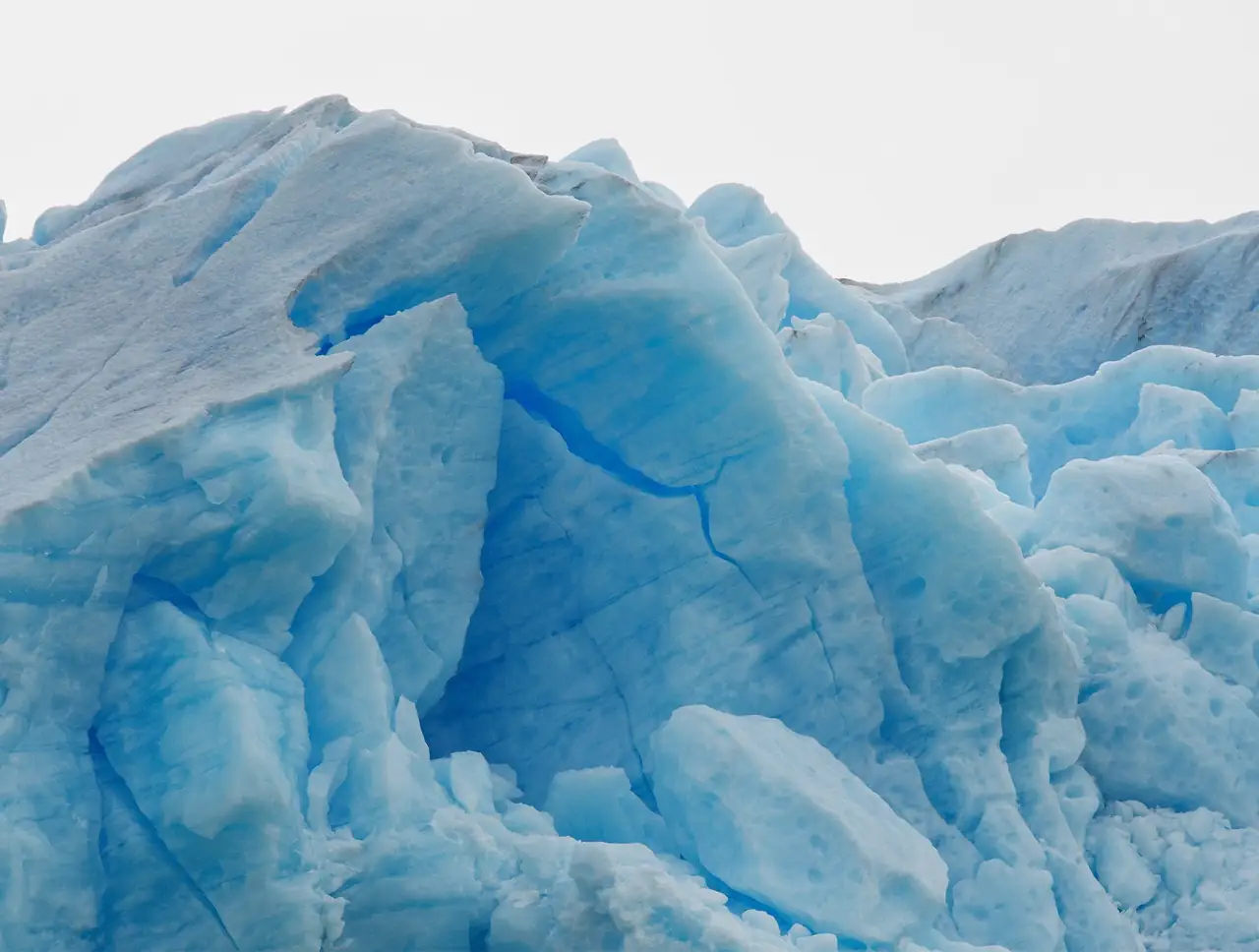
The color is the first surprise. Glacial ice, especially the oldest and most compressed parts, reads as a deep, saturated blue rather than the plain white most people picture. It comes from how densely the ice has been packed over centuries, squeezing out the air pockets that normally scatter light and make ice look white. Once you've seen that blue in person, it's hard to picture a glacier any other way again.
The texture surprised us too. From a distance it looks smooth, almost sculpted. Up close, it's rougher and more varied than that — crevasses, ridges, streaks of darker rock and debris carried along as the ice has moved. It reads less like a single solid mass and more like something with real history written into its surface, which in a very literal sense it is.
The sound is the part nobody mentions
Ice under that much pressure doesn't sit quietly. It groans, cracks, and every so often lets go of a piece with a sound that carries much further than you'd expect across open water — sharp, sudden, closer to a rifle shot or rolling thunder than anything you'd associate with ice. The first time it happened, we genuinely didn't understand what we were hearing, and turned around half-expecting to see something else entirely.
That sound, more than the sight itself, is what stays with people. You can describe the color and the scale reasonably well after the fact. The sound is much harder to explain to someone who wasn't there.
Patience pays off
The temptation is to snap a photo and move on, especially if there's a schedule to keep. The better instinct, when there's time for it, is to stay a while — the light changes, the ice shifts, and if you're lucky, you'll catch a calving event, which is worth far more than the photo you would have taken instead.
- Watch the waterline for smaller pieces breaking off — it often happens before the big ones
- Keep your camera down for a stretch and just listen
- Ask your guide what to watch for; they can often read the ice better than you'd expect
- Don't rush the moment for the next stop on the schedule
It's easy to treat a glacier as one more stop on an itinerary, something to see and check off. Given even a little time and attention, it turns into something closer to an event — unpredictable, a little loud, and genuinely unlike anything else on the trip.
Every glacier is a little different
We'd assumed, going in, that one glacier would look roughly like the next once we'd seen a couple. That turned out to be wrong. Each one had its own shape, its own coloring, its own particular sounds — some quieter and more still, others clearly more active, with ice visibly shifting and cracking throughout the time we spent near them.
That variation is part of what makes it worth seeing more than one if the itinerary allows for it. What felt almost like a formality after the first sighting — 'we've seen a glacier, we know what this is now' — turned out to be nothing of the sort. Each one earned its own reaction.